Quick answer: A sensible ebike commute distance for an average rider is 5-10 miles a day, according to a retailer commuting guide. Check that the battery covers the whole round trip, or plan to charge at work.
For the bigger question behind the switch, namely are electric bikes environmentally friendly, the are electric bikes environmentally friendly hub puts commuting in context. This guide stays practical: how far people ride, what a battery really delivers, and where a commute outgrows one charge.
Typical e-bike commute distances
Everyday distances
An average rider should be able to handle a 5-10 mile commute daily, and for more advanced riders commutes of up to 50 miles a day are realistic, according to the same retailer guide. The guide’s point is that an electric bicycle lets commuters cover much longer distances with much less effort than a traditional bicycle. These figures describe what riders can manage, so treat them as a starting range. The battery then decides whether a specific route works without a recharge.
If you are new to commuting by bike, start at the short end of that band and extend the route once you know how much charge a typical day uses. The advanced figure suits riders who already ride long distances comfortably and who have a bike and battery built for it.
Time on the bike
Distance also sets your travel time. At an average speed of 15 miles per hour, 10 miles takes 40 minutes, so a commute at the top of the average-rider band stays under an hour at that pace. For wider context on how many people are making this switch, see the electric bike sales statistics.
Battery capacity and what range to expect
Battery capacity, measured in watt-hours (Wh), is the main driver of range. As one e-bike guide puts it, the larger the battery, the more power you have available, giving a much further range. When comparing models, read the Wh rating on the spec sheet alongside the claimed mileage, because the claim depends on the conditions it was tested in.
Range claims are best read as ceilings. One guide says e-bikes typically offer between 25 and 75 miles per charge and puts the average range of a commuting electric bicycle at 50 miles. A manufacturer’s own specification shows how wide the spread is within one brand: the TST Flyer is listed at up to 65 miles, while the TST R002 moped-style model is listed at 65-100 miles, with a heavier frame and a higher top speed.
Claimed versus real-world range
The most useful comparison is between a rating and what a rider can expect. For batteries rated at 65 miles, a manufacturer guide suggests 40-55 miles in real-world use, based on pedal-assist level 2-3, a 200 lb rider and mixed terrain.
| Figure | Value | Planning use |
|---|---|---|
| Typical e-bike range span | 25 to 75 miles per charge | Shows how much range varies between models, so check the specific bike. |
| Stated average commuting e-bike range | 50 miles per charge | A rough midpoint for commuter models, not a guarantee for your route. |
| TST Flyer manufacturer rating | Up to 65 miles | A best-case ceiling to discount for load, wind and temperature. |
| Real-world on 65-mile rated batteries | 40-55 miles (assist level 2-3, 200 lb rider, mixed terrain) | Use this lower band, not the rating, when judging a daily round trip. |
| Winter on 65-mile models | 45-50 miles | Use for cold-season commutes when the battery has been warmed first. |
| TST R002 manufacturer rating | 65-100 miles | Suits long commutes, at the cost of more weight. |
The typical-range and average figures come from an e-bike commuting guide, and the model ratings and real-world estimates come from a manufacturer’s commuting guide.
What cuts range on a daily commute
Several factors combine on a real commute. Wind, weight and assist level together can reduce maximum range by 20-30%, according to the manufacturer guide. The sections below separate them so you can see which ones you control.
Pedal-assist level
Assist level is the factor you can change on every ride. The harder you pedal, the less effort the motor puts in and the longer the battery lasts. Dropping to a lower pedal-assist level on flat stretches is the simplest way to stretch a charge.
Class rules also shape how the assist behaves. A Class 1 e-bike has a top assisted speed of 20 mph and the motor engages only when you pedal. A Class 2 bike also tops out at 20 mph, but its speed can be controlled by pedalling or by throttle, and, as Rectrix notes, the harder you work, the longer the battery will last.
Terrain, load and wind
Hills and heavy riding demand more power. An electric mountain bike needs much more power than an electric commuting bike, which is a reminder that steep, rough routes call for a bigger battery than flat city streets.
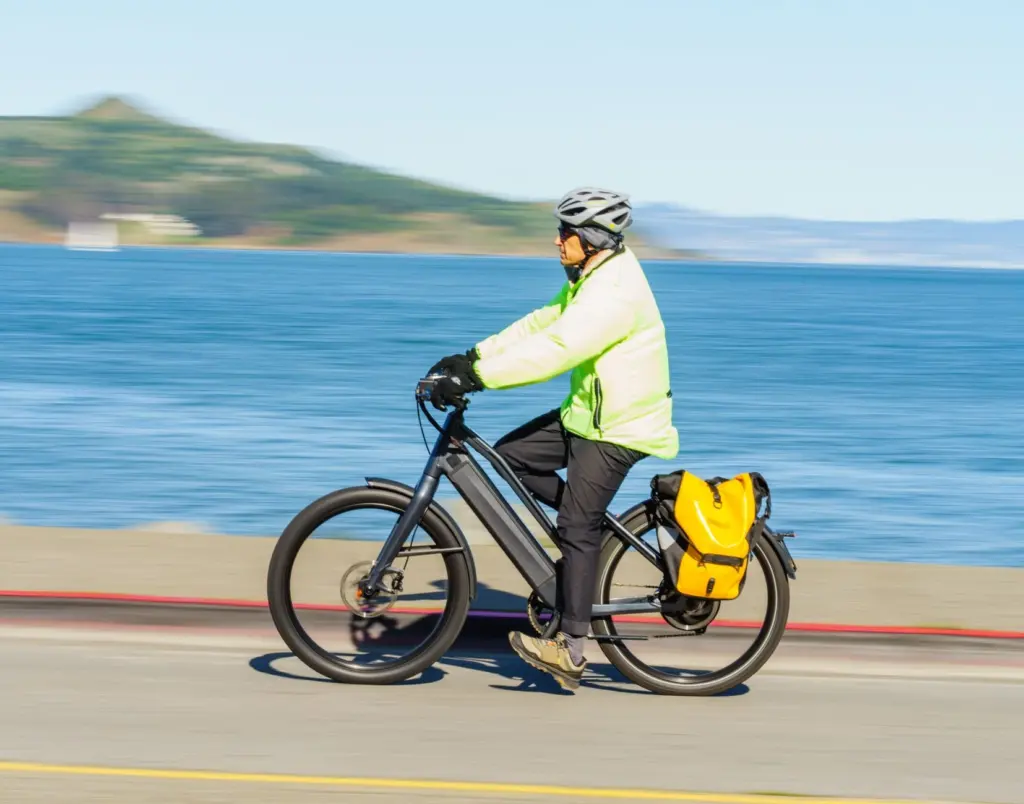
Load and wind matter as well. Heavier loads (up to 450 lbs on the manufacturer’s guidance) or headwinds drop range by about 20%. The bike itself is part of the load, since e-bikes generally weigh 50-60 lbs according to the retailer guide. Panniers, a trailer or a full backpack all add to the demand on the motor, and a headwind on the way home can be as costly as a loaded rack.
Temperature
Cold hurts more than heat. The same manufacturer guide says cold cuts range by 20-30%, so keep the battery warm, while heat reduces it by 10-15%. For winter commuting it advises preheating batteries indoors and expecting 45-50 miles on 65-mile models. If you store the bike in an unheated shed or leave it outside at work, bring the battery inside so it starts the ride warm.
Building a range budget for your commute
A range budget turns a rated figure into a number you can rely on. Work through these steps in order.
- Start from the rating. Note the manufacturer’s range and the battery’s Wh capacity, and treat the rating as a ceiling.
- Move to real-world range. A 65-mile rated battery gives 40-55 miles in mixed conditions, so expect a clear gap between rating and reality.
- Adjust for your conditions. Allow for the 20-30% loss from wind, weight and assist level, and for extra loss in cold weather.
- Compare with your round trip. If you cannot recharge at work, the whole round trip must fit inside the adjusted figure with a margin left over.
When a commute is too long for one charge
A commute is too long for one charge when the round trip leaves no margin against your adjusted range. Short commutes of 5-10 miles sit comfortably inside the typical 25 to 75 mile span even after the 20-30% reductions, so most riders on that distance can skip workplace charging. At the advanced end the picture changes: a commute of up to 50 miles a day matches the stated 50 mile average commuting range, leaving nothing in reserve for a headwind, a cold morning or a detour.
In that case, choose a larger battery, such as a model rated well above your daily distance, or plan to charge during the day. Riders with hilly routes or heavy loads should be especially cautious, because those conditions eat into the margin first.
Extending range and charging at work
The easiest extension is a charge during the working day. Electric bicycle batteries generally take 4-6 hours to fully charge, according to the retailer guide. The manufacturer guide says a full charge from empty on any 110V outlet takes 4-5 hours, and that removable batteries on its models charge in 3-5 hours via standard outlets.
Those times fit within a typical working day, so a removable battery you can carry to your desk is the most practical route to a longer commute. A frame-mounted battery that cannot be removed needs a socket near the bike. Where an outlet is not available, some riders look at ways to charge ebike with solar panel equipment instead.
Habits that stretch a charge
- Pedal harder where it is easy. Lower assist on flat sections saves battery for hills.
- Keep the battery warm. In cold weather, preheat it indoors before the ride.
- Carry less. Weight and headwinds each reduce range by about 20%, so remove loads you do not need.
- Match the bike to the route. Choose a larger battery for hills and longer distances, since steep routes need more power.
Frequently asked questions
How long does a 10-mile e-bike commute take?
At an average speed of 15 miles per hour, a 10-mile ride takes 40 minutes. Hills, junctions and lower assist will lengthen that.
What is the difference between Class 1 and Class 2 e-bikes for commuting?
Both have a 20 mph top speed. On a Class 1 bike the motor engages only while you pedal, while a Class 2 bike can also be driven by throttle.
Does a rear hub motor affect towing a trailer?
It can. An e-bike with a hub motor in the rear may require some modification to the trailer hitch, so check fitment before adding a trailer to a commute.