Who invented the electric bike? No single inventor has an unchallenged claim. The earliest patent in the record is Ogden Bolton Jr.’s, granted on 31 December 1895 for a battery-powered bicycle with a rear hub motor. Commercial success came much later.
The history matters for modern buyers because the same ideas keep returning: motors in the wheel, motors at the pedals and batteries that finally got light enough. For the present-day question of whether are electric bikes environmentally friendly, the wider green-transport guide is the better place to start.
Why credit for the electric bike is split
Credit is split because “first” can mean three different things: the first patent, the first competing design and the first commercially successful product. Each has a different answer, and mixing them up is how most disputes start.
- Earliest patent: Bolton’s 1895 grant is described by one bicycle retailer’s history as what appears to be the very first patent. That wording is cautious, and it is right to be: it is a secondary account, not a patent-office listing.
- Competing early designs: Charles Theryc is credited in a secondary account with a planetary geared hub motor in 1896, and H.W. Libbey of Boston received a US patent in 1897. Neither displaces Bolton on date, but both show the idea was not confined to one workshop.
- First commercial success: Yamaha’s 1993 pedal-assist bike is described as one of the first commercially successful machines of its kind. The phrase “one of the first” leaves room for other early sellers.
If you need a single sentence for a school project or a quiz answer, Bolton is the safest name for the earliest patent. Call him the earliest patent holder on record, not the sole inventor of the electric bike.
Early patents and what they actually built
Bolton’s 1895 rear hub motor
Ogden Bolton Jr., an American inventor, was granted his patent on 31 December 1895 for a battery-powered bicycle with a rear hub motor, according to the retailer’s history. The battery was a 10-volt unit.
An engineering write-up on vbikesolutions.org describes the motor as a hub design with a 6-pole magnet. It says the battery had to carry about 100 amperes at 10 volts, which the author calculates as roughly 1000 watts. That figure is the author’s own estimate, so treat it as an indication of the design’s demands rather than a measured rating. It does show why the idea was hard to make practical: a low-voltage battery had to deliver a very large current.
Libbey, Theryc and Steffens
H.W. Libbey of Boston was granted a US patent on 28 December 1897 for a bicycle with an electric motor in the crankset hub. In 1898 Mathew J. Steffens patented a rear-wheel drive electric bicycle that used a belt around the wheel. Both accounts come from the same retailer history.
Reading these together, the early inventors tried a hub motor, a crank-mounted motor and a belt drive within a few years of each other. That spread is the best argument against crowning one inventor: the layouts competed, and the field was being worked on in parallel.

Electric bike timeline at a glance
The table below puts the dated milestones in order and says how much weight each one can bear.
| Year | Milestone | How to read it |
|---|---|---|
| 1895 | Ogden Bolton Jr. patent (31 December), rear hub motor, 10-volt battery | Earliest patent in the record; secondary-source wording is “appears to be” the first |
| 1896 | Charles Theryc introduces a planetary geared hub motor | Secondary account; a design innovation, not a confirmed patent date |
| 1897 | H.W. Libbey patent (28 December), motor in the crankset hub | Shows a rival layout soon after Bolton |
| 1898 | Mathew J. Steffens patents a belt-driven rear-wheel electric bicycle | A third drive approach |
| 1932 | Philips & Simplex electric bike with a heavy steel frame and lead-acid battery | Evidence that weight was the persistent obstacle |
| 1989 | Michael Kutter develops the pedelec pedal-assist system | Basis of the pedal-assist category |
| 1993 | Yamaha introduces a pedal-assist e-bike with a frame-mounted motor | “One of the first” commercially successful, not necessarily the first |
These entries draw on a retailer’s electric bike history and a motor-technology history.
Cyclemotors are a separate line
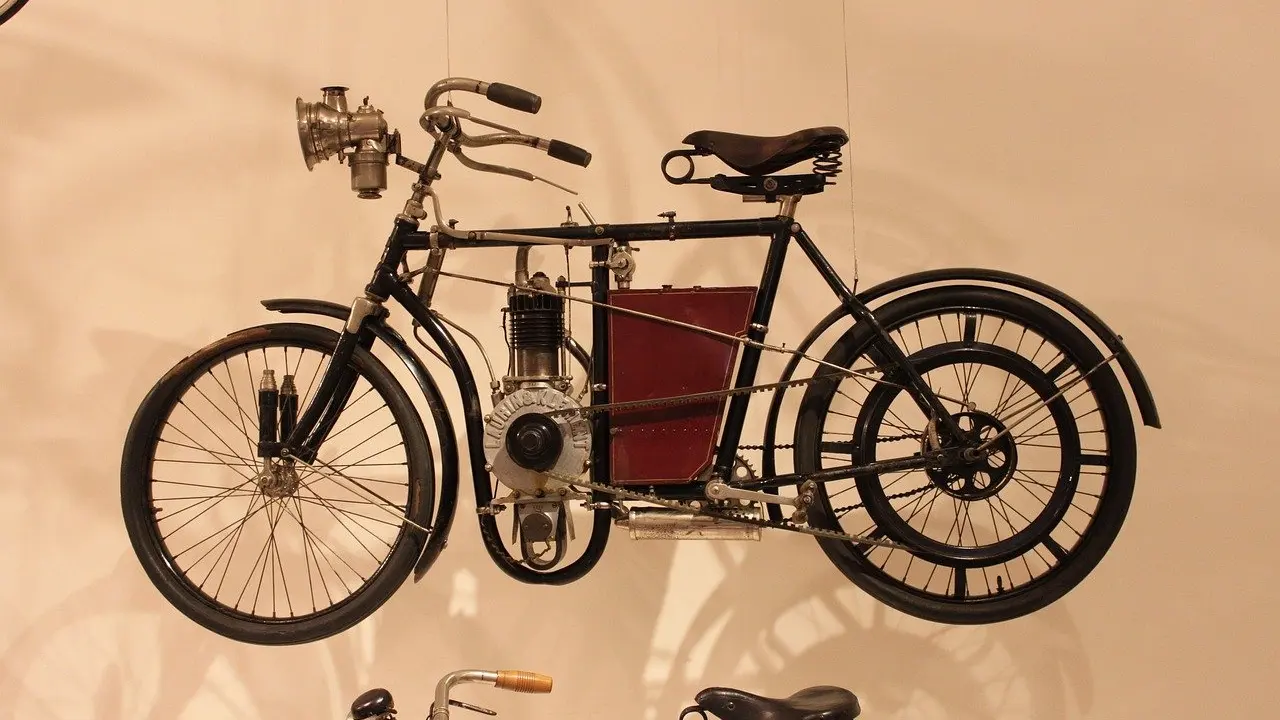
A cyclemotor is a small engine fitted to an ordinary pedal bicycle, and it belongs to the history of motorised bicycles rather than electric ones. The patents in the timeline above are electric. A date for an early engine-assisted bicycle does not transfer to Bolton, Libbey or Steffens, and their dates do not transfer to cyclemotors.
The two lines do share one idea: add power to a bicycle that already exists. That is why hub motors, which apply power directly to the wheel and bypass the bike’s drivetrain, could later be retrofitted to conventional bicycles. When you read a claim that something was “the first motorised bicycle”, check whether the power source was an engine or a battery before accepting it as an e-bike first.
Technologies that made e-bikes practical
Hub motors
The hub motor appears in Bolton’s 1895 patent and in Theryc’s 1896 geared version. Its lasting appeal is simple: power goes straight to the wheel, so the bicycle’s own drivetrain is untouched. That is the property that makes it suitable for adding to a standard bicycle, and it is the reason hub motors dominate conversion thinking today.
Pedal assist
Swiss engineer Michael Kutter developed the pedelec system in 1989, according to the motor-technology history. Pedal assist ties the motor to the rider’s pedalling instead of a throttle alone. It is the feature that turned the electric bicycle into a product people could treat as a bicycle, and Yamaha’s frame-mounted motor in 1993 built on it.
Batteries from lead-acid to lithium-ion
Weight was the long-running problem. A Philips & Simplex electric bike from 1932 is described with a heavy steel frame and a very large lead-acid battery, and an industry history from Furo Systems says early e-bike batteries were bulky and very heavy. Chemistries such as lead-acid and nickel-metal hydride are the older background to the lithium-ion shift.
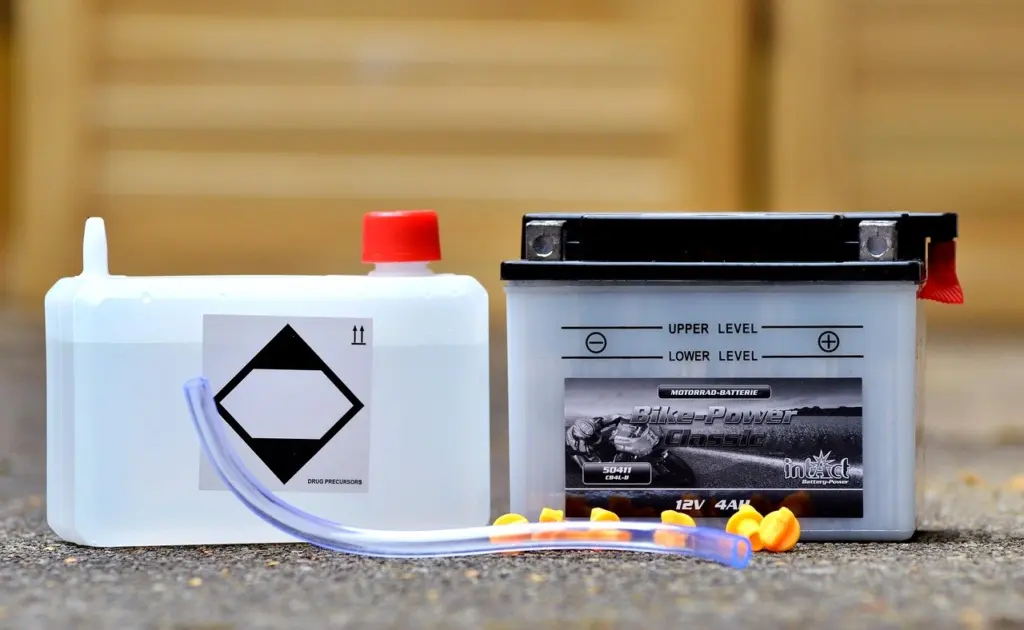
Lithium-ion is where sources differ on wording. Furo Systems dates the solution to 1991, with the invention of the lithium-ion battery. The motor-technology history says lithium-ion was commercialised in the 1990s and describes the packs as up to 70% lighter than lead-acid. Those accounts are compatible: a 1991 date for the invention fits commercial use through that decade. The 70% figure is a comparison from one secondary source and should be read as “up to”, not as a typical saving.
Battery chemistry also sets how long a bike stays useful, which is covered in the guide on how long do electric bikes last.
When e-bikes became commercially available
Pedal-assist electric bikes were being sold successfully by 1993, when Yamaha introduced one of the first commercially successful models with a frame-mounted motor. The 1932 Philips & Simplex bike and the 1895 to 1898 patents show that electric bicycles existed earlier, but a patent or a single heavy machine is not the same as a product range.
The sequence that follows from the evidence is straightforward. The patents set out the layouts, pedal assist in 1989 changed how the motor was used, and lighter lithium-ion packs in the 1990s removed the weight penalty. Only then did a commercially viable bike appear. If you are choosing between a hub motor and a frame-mounted motor today, that history says both approaches are old and both have worked.
Rules for riding vary by place, so before buying read where can you ride an electric bike.
Frequently asked questions
Is Bolton’s 1895 bicycle the same as a modern e-bike?
Not in practice. It used a hub motor with a 10-volt battery, which the engineering write-up says had to carry about 100 amperes. Modern bikes add pedal assist and lighter lithium-ion packs.
Does an early patent prove the bike was built and sold?
No. A patent records a design and its date. The evidence for commercial success is later: Yamaha’s pedal-assist bike in 1993 is described as one of the first commercially successful models.
Is a cyclemotor an electric bike?
No. A cyclemotor is an engine fitted to a pedal bicycle, so its history is separate from the battery-powered patents listed above.
Do pedal-assist e-bikes need a licence in the UK?
For electrically assisted pedal cycles, an industry summary says riders must be over 14 and do not need a licence, registration or insurance. Check current official rules before riding.